
Cannabis 101
What it is, what it does, and what to expect — written for patients who are starting from zero.
This guide assumes you have never used cannabis, or used it once a long time ago and did not much like it. It does not assume you know what a cannabinoid is, what THC stands for, or why anyone would take a medicine in five different forms.
There is nothing to be embarrassed about in not knowing. Most of what is written about cannabis is written either by people selling it or by people campaigning against it, and almost none of it is written for a patient sitting at a kitchen table wondering what they have just agreed to.
Nothing here is a prescription. It is background, so that the conversation with your doctor starts further along.
Download this guide as a PDF — 22 pages · to print or read offline
What is in this guide
- Three things before anything else
- What cannabis actually is
- THC and CBD — the two words that matter
- Why it works at all
- What the evidence supports
- What it will not do
- The ways of taking it
- What it feels like the first time
- The one rule: start low, go slow
- If you take too much
- Driving, working, and where you may use it
- What is legal in Costa Rica
- Keeping it safe at home
- What to bring to your consultation
- Words you will hear
- Sources
Three things before anything else
One. This does not replace your consultation. A doctor who has your history, your medicines and your test results will tell you things this guide cannot. If the two ever disagree, the doctor is right.
Two. You will not be judged. Patients routinely arrive apologising — for having tried it already, for not having tried it, for not knowing the words. None of that matters clinically. What matters is that you say out loud what you are actually taking and how much.
Three. Cannabis is a medicine with a dose. That is the single idea this whole guide rests on. Too little does nothing. Too much causes the effects people are afraid of. The right amount is usually far smaller than people expect, and finding it is a process rather than a guess.
What cannabis actually is
Cannabis is a plant. Its flowers contain several hundred different chemical compounds, and a few dozen of those are the ones with effects on the human body. Those are called cannabinoids.
Two cannabinoids are present in large enough amounts to matter for most patients: THC and CBD. Nearly everything written about cannabis as a medicine is really about the balance between those two.
The plant also contains terpenes — the oils that give it its smell, and the same family of compounds that makes pine smell like pine and lemon peel smell like lemon. They probably contribute to how a given product feels. How much is still argued about.
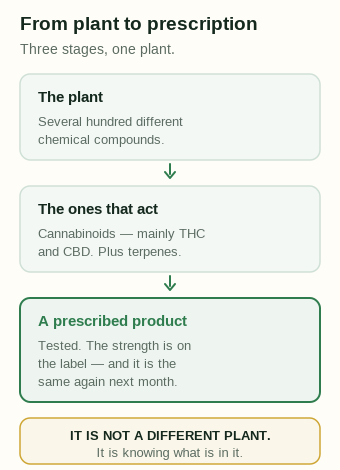
The difference between medical cannabis and the cannabis someone's cousin grows is not a different plant. It is that a prescribed product has been tested, so the strength is on the label, the same bottle is the same strength next month, and someone qualified chose it for your condition. That is the whole of the difference, and it is the entire reason the clinic exists.
THC and CBD — the two words that matter
| THC | CBD | |
|---|---|---|
| Full name | Tetrahydrocannabinol | Cannabidiol |
| Does it cause a "high"? | Yes, at high enough doses | No, at any dose |
| Mainly used for | Pain, nausea, appetite, muscle spasm, sleep | Inflammation, anxiety, seizures, pain alongside THC |
| Main unwanted effects | Dizziness, sleepiness, dry mouth, anxiety or a racing heart if the dose is too high | Usually mild — tiredness, loose stools, appetite change |
| Interacts with other medicines? | Yes | Yes — more than most people expect |
Two things patients are regularly surprised by:
- CBD is not "the safe one you can ignore." It is a real drug with real interactions, particularly with blood thinners and epilepsy medicines. In Costa Rica a daily CBD dose above a set threshold legally requires a prescription for exactly this reason — see What is legal in Costa Rica.
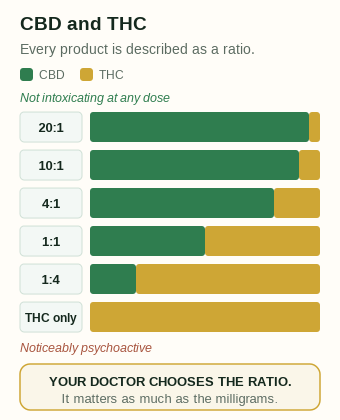
- Most medical products contain both. They are usually described as a ratio, written CBD:THC. A 20:1 product is mostly CBD with very little THC. A 1:1 product is balanced and will be noticeably psychoactive. Your doctor chooses the ratio, and it is as much a part of the prescription as the number of milligrams.
Why it works at all
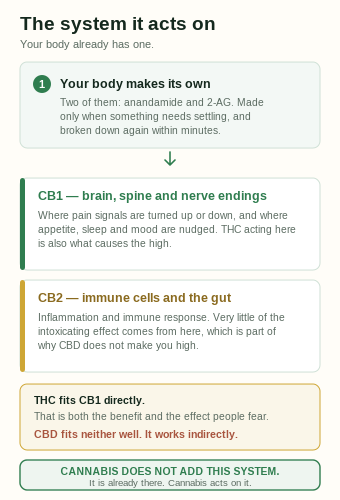
Your body already has a system that these compounds fit into. It is called the endocannabinoid system — receptors spread through the brain, the nerves, the gut and the immune cells, plus the body's own molecules that switch them on. It helps regulate pain, appetite, sleep, mood and inflammation.
Cannabis works because the compounds in the plant happen to fit those same receptors.
Two practical consequences follow from that, and they explain most of what patients find confusing:
- It affects many systems at once. That is why one medicine can plausibly help pain and sleep and appetite — and also why it can cause dry mouth and dizziness while it does so.
- People differ enormously. The same dose that does nothing for one person is too much for another. This is normal, it is not a sign that something is wrong with you, and it is the reason nobody can tell you your dose in advance.
What the evidence supports
Cannabis is neither a miracle nor a fraud, and the honest answer is that the evidence is strong for a few things, promising for several more, and thin for a great many claims made on the internet.
The most careful review of the whole field remains the United States National Academies of Sciences, Engineering, and Medicine report of 2017, which sorted the evidence into tiers. Its strongest tier — conclusive or substantial evidence of effectiveness — contains three uses:
- Chronic pain in adults.
- Nausea and vomiting caused by chemotherapy, with cannabinoids taken by mouth.
- Spasticity in multiple sclerosis, measured as the patient's own report of their symptoms, with cannabinoids taken by mouth.
Separately, a purified CBD medicine is an approved prescription drug for three rare and severe childhood epilepsy syndromes — Dravet syndrome, Lennox-Gastaut syndrome and tuberous sclerosis complex. That approval is for a specific pharmaceutical product, not for CBD oil bought in a shop.
Costa Rican law lists its own set of qualifying conditions, which is what actually governs whether you can be prescribed here: multiple sclerosis, spinal cord injuries, cancer therapy, hepatitis, HIV/AIDS, Tourette syndrome, epilepsy, glaucoma, and chronic pain. Conditions such as autoimmune disease and fibromyalgia are not named in the law but may still qualify after a physician's evaluation.
Where the evidence is promising but weaker — meaning some good studies, some disagreement, and a sensible doctor may still try it: sleep disturbance, anxiety, appetite loss, and several inflammatory conditions.
What it will not do
This section exists because patients arrive having read otherwise, and because a clinic that will not say this plainly cannot be trusted on anything else.
- Cannabis does not cure cancer. It has a genuine and well-evidenced role in managing the effects of cancer and its treatment — nausea, pain, appetite. That is not the same thing, and the difference has cost people their lives when they abandoned treatment that was working.
- It is not a replacement for a medicine you are already on, unless and until a doctor says so. Never stop a prescription to start this one.
- It is not addiction-free. Regular heavy use of high-THC products can lead to dependence. At medical doses this is uncommon, but "uncommon" is not "impossible", and it is worth knowing before you start rather than after.
- It does not work for everyone. A meaningful number of patients try it properly, give it a fair run, and find it does not help them. That is an acceptable outcome and a reason to tell your doctor, not to quietly double the dose.
The ways of taking it
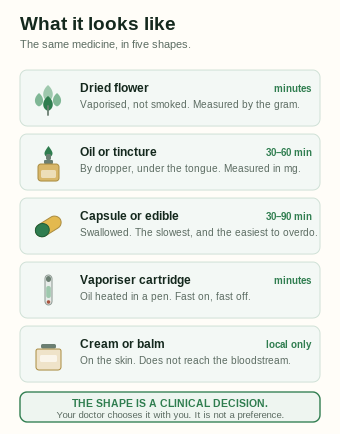
The form you take it in changes how fast it works, how long it lasts, and how easy it is to get the dose right. It is as important a decision as the strength.
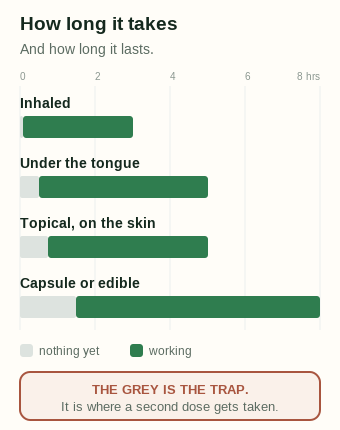
| Form | Starts working | Lasts | Easy to dose? | Notes |
|---|---|---|---|---|
| Inhaled (dry herb inhaler, vaporiser) | Minutes | 1–3 hours | Hard | Fastest relief, so useful for breakthrough pain. Short-lived. |
| Tincture / oil under the tongue | 15–45 minutes | Several hours | Easy | Measured by dropper. The usual starting point. |
| Capsules and edibles | 30–90 minutes | 4–8 hours | Easy if the product is labelled | Slowest to arrive, longest to last, easiest to overdo by taking a second dose too soon. |
| Topical (cream, balm) | 15–60 minutes, locally | Hours | Easy | Acts where you put it. Does not cause a high. |
Smoking is not recommended, and no doctor at this clinic will suggest it. Burning plant material damages the lungs whatever the plant is. If inhaling is right for you, a vaporiser or a dry herb inhaler heats the material without setting fire to it.
The single most common beginner's mistake is with edibles and capsules. Nothing is happening after forty minutes, so a second dose goes down, and then both arrive at once. If you take something by mouth, the rule is to wait the full time before deciding it has not worked. There is a separate clinic guide for patients taking cannabis by mouth; ask for it if that is your route.
What it feels like the first time
For most patients, at a properly low starting dose: very little. That is intentional, and it is not a wasted dose — it is how your doctor finds out how sensitive you are before anything unpleasant can happen.
As the dose rises to something therapeutic, the common experiences are:
- Mild sleepiness, often the point of an evening dose
- Dry mouth
- Slight light-headedness, especially standing up quickly
- A faster heartbeat for a while
- With THC, a mild floating or softened feeling, and sometimes the sense that time has slowed
Most of what people fear is the experience of too much, not of cannabis. Taken in small steps, the unpleasant end is something you can simply stop before you reach.
The one rule: start low, go slow
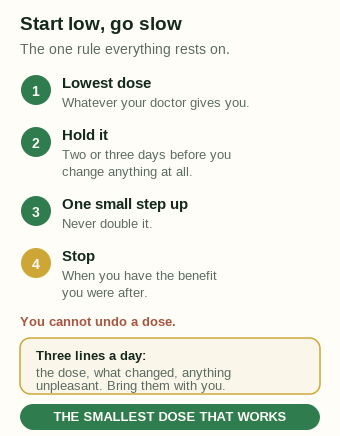
If you remember one thing from this guide, remember this. It is the standard of care in every clinical guideline on medical cannabis, for one reason: you cannot undo a dose you have already taken.
- Start at the lowest dose your doctor gives you, even if it seems trivially small.
- Take it at the same time of day, usually in the evening to begin with, so that any sleepiness lands somewhere harmless.
- Hold that dose for two or three days before changing anything. The effect of a steady dose is not the same as the effect of the first one.
- Increase in small steps, not by doubling.
- Stop increasing when you have the benefit you wanted. The goal is the smallest dose that works, not the largest you can tolerate.
- Keep a short log — date, time, dose, what changed, anything unpleasant. Three lines a day. Bring it to your follow-up. It is the single most useful thing a patient can hand a doctor.
If a dose causes something you do not like, go back down to the last one that was comfortable and tell your doctor. That is not a failure. It is the system working exactly as intended.
If you are over 60, begin lower and move more slowly still. Older patients are more sensitive, more likely to be taking several medicines, and more likely to be hurt by a fall than by the cannabis. Half of a starting dose is a reasonable place to begin.
If you take too much
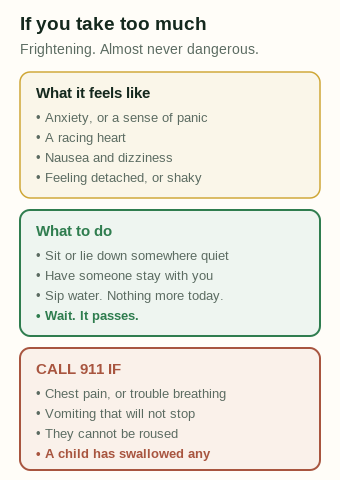
It happens, most often with something taken by mouth. It is frightening, and for an otherwise healthy adult it is almost always not dangerous. It passes.
What it feels like: anxiety or a sense of panic, a racing heart, nausea, dizziness, feeling detached or unreal, sometimes shaking.
What to do:
- Sit or lie down somewhere quiet, cool and familiar.
- Tell someone, and ask them to stay with you. Being alone is what makes it frightening.
- Sip water. Do not drink alcohol and do not take more of anything.
- Wait. Inhaled, it will fade within a few hours. Taken by mouth, it can take longer — most of a day in the worst cases.
- Write down afterwards what you actually took, and tell your doctor. That number is useful, not incriminating.
Get emergency help — call 911 in Costa Rica — if:
- There is chest pain, or difficulty breathing
- There is vomiting that will not stop
- The person cannot be roused, or is confused in a way that is getting worse
- A child has swallowed any of it. Do not wait to see what happens. A dose that is mild for an adult is not mild for a small body.
Driving, working, and where you may use it
- Do not drive after a dose, and do not drive the next morning after an evening dose until you know how you react to it. THC impairs reaction time and judgement of distance, and having a prescription is not a defence. Costa Rica has a separate clinic guide on cannabis and driving — ask for it.
- Public consumption is prohibited in Costa Rica even with a valid prescription. Use it at home.
- Tell your employer if your work requires it — operating machinery, driving, medical or security work. Check your contract rather than assume.
- Travel. Do not assume a Costa Rican prescription protects you in another country. Most of the time it does not. Ask before you fly.
What is legal in Costa Rica
Recreational cannabis is not legal. What is legal is medical cannabis with a prescription, under Law 10113, passed in 2022.
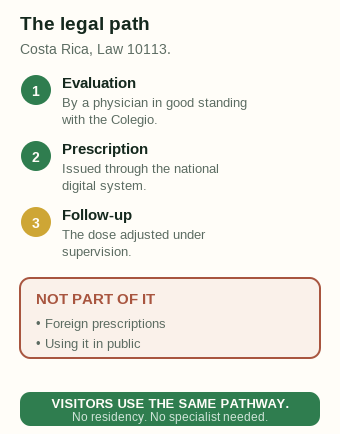
The rules that catch people out:
- Products with 1% THC or more by dry weight require a prescription, always, whatever the dose. Below 1% it is classed as hemp. The law counts delta-8, delta-9 and delta-10 THC towards that 1% — worth knowing, because delta-8 products are sold as "legal hemp" in other countries.
- CBD has a second, separate line: a daily dose above 70 mg requires a prescription. The bottle on the shelf tells you nothing about which side of that line you are on — it depends entirely on how much of it you take each day.
- Foreign prescriptions are not valid here. You need one from a Costa Rican physician, and visitors use the same pathway as residents.
- Public consumption is prohibited, prescription or not.
Who can prescribe: any physician in good standing with the Colegio de Médicos y Cirujanos. You do not need a specialist, and you do not need residency.
Keeping it safe at home
- Keep it in the original, labelled container. Decanting into something unmarked is how doses get confused and how children find it.
- Out of reach and out of sight, ideally locked. Anything that looks like food needs more care than a bottle does.
- Away from pets. Dogs are badly affected and will eat an entire container given the chance. If a pet gets into it, call a vet straight away.
- Cool and dark. Heat and sunlight degrade it; a cupboard is better than a windowsill. Check the label for whether it belongs in the fridge.
- Do not share it. It was prescribed against your history and your other medicines, and it is a prescription medicine in law.
What to bring to your consultation
Have these ready and the appointment will go much further:
- Every medicine and supplement you take, with the doses. Photographing the boxes is the easiest way.
- Your conditions and your main symptom, and which one you most want improved. "Pain" is a start; "I cannot sleep more than three hours because of the pain in my knee" is far more useful.
- What you have already tried, including cannabis if you have tried it, and what happened. Especially if it went badly.
- Any history of psychosis, schizophrenia or serious substance problems — in you or in your family.
- Whether you are pregnant, breastfeeding or planning to be.
- What your days require of you — driving, machinery, caring for someone, the kind of work you do.
Words you will hear
- Cannabinoid — one of the active compounds in the plant. THC and CBD are the two main ones.
- THC — the one that causes a high at sufficient dose. Also the one doing much of the work in pain, nausea and spasm.
- CBD — not intoxicating, used for inflammation, anxiety and seizures, and the source of most drug interactions.
- Ratio — the balance of CBD to THC in a product, written like 20:1.
- Terpenes — the aromatic oils; the smell, and possibly part of the effect.
- Full spectrum — contains the whole range of plant compounds, including trace THC. Broad spectrum — the same with the THC removed. Isolate — one purified compound alone.
- Tincture — a liquid taken by dropper, usually under the tongue.
- Titration — the process of starting low and adjusting a dose upward in steps. What this guide calls "start low, go slow".
- Certificate of analysis (COA) — the lab report showing what is actually in a product. A reputable product has one; ask.
Sources
- National Academies of Sciences, Engineering, and Medicine (2017). The Health Effects of Cannabis and Cannabinoids: The Current State of Evidence and Recommendations for Research. The source of the three conclusive-or- substantial-evidence conclusions quoted above.
- Health Canada. Understanding cannabis health effects: how to reduce your risk, canada.ca — the quoted wording on pregnancy and breastfeeding, on genes and family history, and on the brain developing "through your 20s and extending into your 30s."
- Health Canada. Cannabis health effects, canada.ca campaigns — "Avoid cannabis completely if you are at risk for mental health problems, especially" psychosis, schizophrenia, problematic substance use.
- Health Canada. Health effects of cannabis on adults over 55, Cannabis Resource Series — for the older-patient caution.
- MacCallum CA, Russo EB. Practical considerations in medical cannabis administration and dosing. European Journal of Internal Medicine 2018;49:12–19. The standard clinical reference for start-low-go-slow.
- MacCallum CA et al. Is medical cannabis safe for my patients? A practical review of cannabis safety considerations. European Journal of Internal Medicine 2021. For the interaction material.
- Canadian Pharmacists Association, Cannabis dosing and titrating, patient guide — low start, small steps, keep a log.
- Cura Vida Cannabis Clinics, published patient guides — Is Weed Legal in Costa Rica?, When CBD Needs a Prescription in Costa Rica, and Choosing the Right Cannabis Product: Routes Compared. The Costa Rican legal section, the qualifying conditions and the route timings are taken from the clinic's own published wording so that this guide cannot contradict the website.
- Ley 10113, article 2. The 1% THC threshold and its coverage of delta-8, delta-9 and delta-10 were read directly from the law on 30 October 2026: cannabis psicoactivo is THC "igual o mayor a un uno por ciento (1%) en peso seco". ---